Don't Sacrifice the Dress
The dress was never the problem. A sketchbook study of hijab colours that don't match and still belong together.
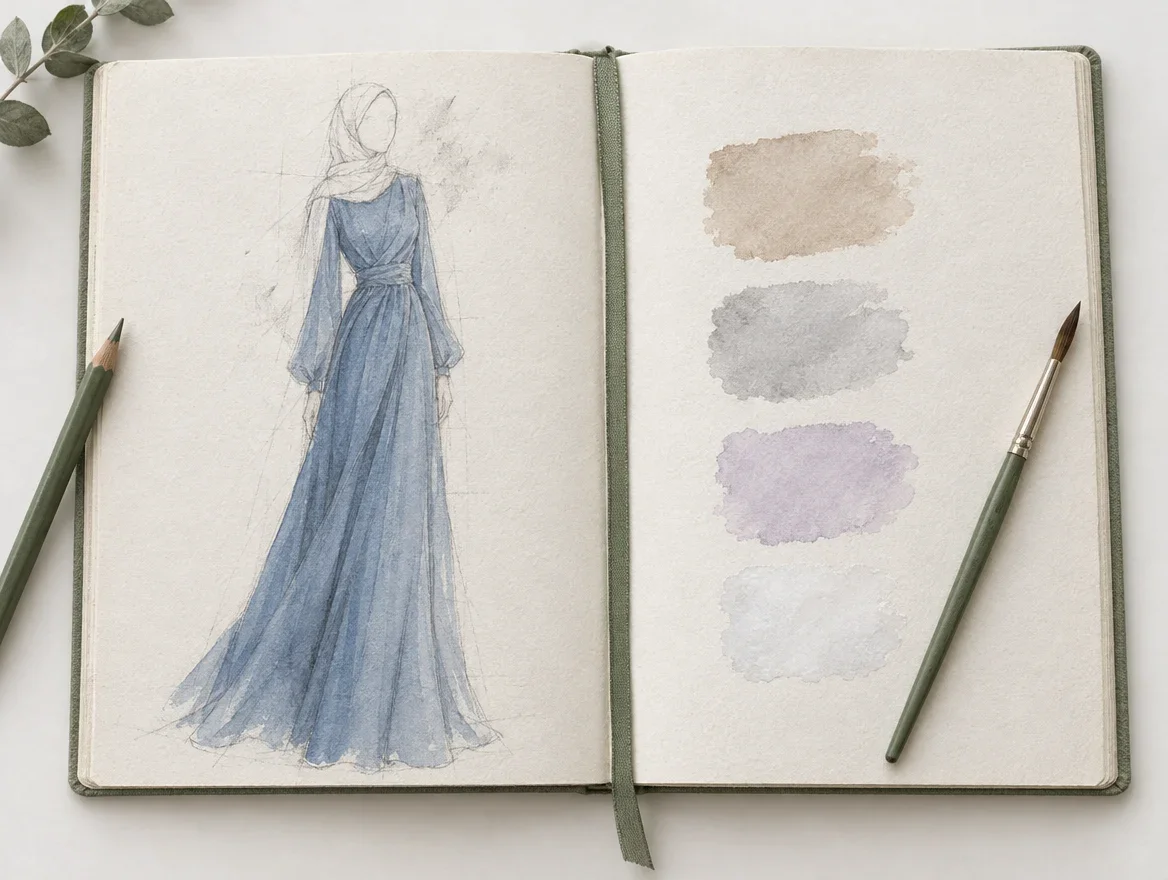
Every wardrobe has one. The dress you loved the moment you saw it, the one still hanging with the tag on. It was never the wrong dress. You just couldn't find a hijab in exactly the same shade, so it waited for an occasion that never came.
Picture it as a page in a sketchbook. A pencil drawing of the dress, and a small handwritten note beside it: "I loved this one." Then the hijab, drawn in the same blue. Erased. Drawn again, a little closer. Erased again. The page gets grey with trying.
Now stop chasing the exact shade and pick up a different colour. Beige. Soft grey. A pale lavender. Each one changes the drawing, and none of them is wrong.
The dress was never the problem
The rule we grow up with is simple: the hijab should match the dress. Sometimes it should. A perfect match looks calm and finished, and if you love it, keep it. But it is one option, not the only one. When it becomes the only option, beautiful dresses stay in the cupboard.
Colours don't have to match to belong together.
1. Start with the dress, not the match
Look at the dress first. Is it bold or quiet? Plain or printed? A strong colour usually wants a calmer hijab beside it, and a quiet dress can carry a little more colour near the face. You are not looking for a copy. You are looking for a partner.
2. Pick a quieter partner
Neutrals sit beside almost any dress without competing with it: sand, beige, milk white, nude, silver grey. They frame the face and let the dress be the main story.
- Beige Moja Modal Cotton Hijab · AED 19.49
- Milk White Modal Cotton Crinkle Hijab · AED 19.99
- Silver Grey Modal Cotton Crinkle Hijab · AED 20.49
3. Borrow a colour from the print
A printed dress already gives you a palette. Find a small colour in the print, a leaf, a border or a dot, and wear that one as the hijab. The outfit connects without the hijab trying to be the dress.
4. Go one step lighter or darker
If you love the colour of the dress, wear it a step away. A lighter or deeper tone of the same family looks considered instead of searched for. Navy with a soft denim. Wine with dark wine. Brown with nude brown.
- Denim Moja Modal Cotton Hijab · AED 19.49
- Dark Wine Modal Cotton Crinkle Hijab · AED 21.99
- Nude Brown Modal Cotton Crinkle Hijab · AED 20.99
5. Let a soft contrast lead
Some pairs work because they are different. A pale lavender beside a navy dress. Sage green with a rust or brown dress. Milk white with almost anything darker. The contrast keeps the colours soft, so the result stays gentle, not loud.
- Pastel Lavender Moja Modal Cotton Hijab · AED 19.49
A colour study: one blue dress, four hijabs
- Beige: warm and easy, the everyday version.
- Silver grey: cool and calm, good for work and evenings.
- Pastel lavender: soft and a little playful.
- Milk white: clean and bright, lovely in daylight photos.
Same dress, four different moods. None of them is the "right" one. The right one is the one that feels like you that day.
Should my hijab match my dress exactly?
It can, and a perfect match looks lovely. It just doesn't have to. A neutral, a colour from the print, or a shade lighter or darker can work just as well, and sometimes better.
Which hijab colours go with almost everything?
Soft neutrals: sand, beige, nude, milk white and silver grey. Keep two or three of these and most of your wardrobe opens up.
How do I choose a hijab for a printed dress?
Pick one small colour from the print and wear that, or choose a plain neutral so the print stays the hero.
The next time a dress waits in the cupboard because nothing matches, try a different colour. The dress was never the problem.
Don't sacrifice the dress.